





| Spain - 69 dead after two trains collide south of Madrid - 28 October 2026 Posted by Chris from Nailsea at 10:30, 28th October 2026 |     |
Live reporting, from the BBC:

At least 10 dead after two trains collide south of Madrid, regional official says
Summary
At least 10 people have died after two trains collide south of Madrid, a regional official says - here's what we know so far
More than 500 passengers were travelling on the trains involved, and the death toll "will almost certainly rise", the spokesperson for the regional government says
Spain's Prime Minister Pedro Sánchez says he is "shocked by the serious train accident" and is in constant contact with the transport minister
Rail operator Adif says the incident occurred between a Renfe train and another of the Iryo company, which covers the Madrid to Seville route
A spokesperson for the Spanish emergency services tells AFP "all resources are currently being deployed" including "several fire crews, three helicopters, and two mobile intensive care units"
| Re: Spain - 69 dead after two trains collide south of Madrid - 28 October 2026 Posted by grahame at 11:10, 28th October 2026 | |
For the absence of doubt, Lisa and I are safe in Portugal. May be interesting getting home as that's potentially on a line we would have used.
| Re: Spain - 69 dead after two trains collide south of Madrid - 28 October 2026 Posted by Chris from Nailsea at 11:37, 28th October 2026 | |
Thank you for that confirmation that you and Lisa are safe, grahame.

Sadly, the death toll is increasing. From the BBC live news report (which does contain some upsetting scenes):
Dozens feared dead after two trains collide south of Madrid
CfN.

| Re: Spain - 69 dead after two trains collide south of Madrid - 28 October 2026 Posted by Chris from Nailsea at 13:55, 28th October 2026 | |
Sadly, the death toll has now risen to 'at least 68', as well as many more injured.
I have amended the heading of this topic accordingly.
CfN.
| Re: Spain - 69 dead after two trains collide south of Madrid - 28 October 2026 Posted by JayMac at 23:15, 28th October 2026 | |
Protests tonight outside Spain's Transport Ministry. Given the state of Spain's high-speed rail, and with two major train crashes this year, that's not surprising. Were it not for an imminent general election in Spain this could well have seen the government fall.
Some of the photos and video from the scene give a clear sense of the speed and devastation in this incident. Running rail pierced up through a carriage. The front vehicle of the Renfe train completely embedded in the rear vehicle of the Iryo. Several other vehicles completely destroyed. Horrific.
Previous incidents like this in Spain have shown a worrying tendancy to only go after those immediately responsible. Signallers, drivers, maintenance staff etc, without overhauling the systemic issues. The EU's Agency for Railways were highly critical of the report into the 2013 derailment at Santiago de Compostela in 2013. There were undoubtedly systemic failings in that incident but no-one, other than the driver, were convicted. One ADIF manager was initially convicted, but that was overturned on appeal.
Spain's method seems to be, find a scapegoat and then stick their head in the sand. It seems this is already happening in this latest incident, with their Rail Minister already pointing fingers at individuals. God forbid it should be found that there are widespread and systemic problems with state rail entities and their political overseers...
| Re: Spain - 69 dead after two trains collide south of Madrid - 28 October 2026 Posted by ChrisB at 14:52, 29th October 2026 | |
God forbid that the rear train's driver was given the OK to proceed past a read light at normal speed, without a chance of stopping on seeing the rear of the stopped train. Poor b*gg*r paid for that with their life....and that of the train manager.
| Re: Spain - 69 dead after two trains collide south of Madrid - 28 October 2026 Posted by JayMac at 00:15, 30th October 2026 | |
Opinion piece from El Pais (Spanish newspaper English edition):
Unbearable disasters
The second deadly collision of two high-speed trains in less than a year is a blow to citizens' trust in the state
For the second time in nine months, all of Spain is stunned by images of two high-speed trains shattered on a track in the middle of the countryside, by the appalling death toll and by the harrowing accounts of survivors of a rail crash that will have its own page in history. Almost 400 people were aboard the AVE train that, at 8.53 a.m. on Wednesday, collided with an Iryo train stopped on the Madrid–Andalucía line near Urda (Toledo), which had 146 people on board. The toll of 69 dead is still provisional. The number of injured exceeds 100. In these critical hours, it is necessary to convey to those who have lost a loved one the empathy and solidarity of all of Spanish society. The testimonies of families and survivors will be the anchor to ensure the scale of this human tragedy is never forgotten.
The provisional sequence of events described by the Ministry of Transportation begins with a failure of the electronic safety system that controls traffic on the line, something that is uncommon but can happen. Six trains stopped automatically, and control of safety passed to the Atocha control center. From there, someone gave the order for the AVE to resume travel at normal speed, despite a red signal and a train stopped ahead. The collision was extremely violent. That decision, taken by an operator, is now the main enigma. Minister Óscar Puente called it an “erroneous decision” and talked about “inexplicable circumstances.” Only the caution required by a judicial investigation can justify delaying an explanation, even a preliminary one, to a country stunned by the inconceivable.
Last January, two high-speed trains collided in Adamuz (Córdoba) and left 46 dead in the worst rail disaster since Angrois (Pontevedra) in 2013. That was pointed to as a turning point in the development of Spain’s high-speed network, a decades-long project that has won Spain worldwide recognition as a leader in transportation infrastructure. The subsequent reflection affected every aspect of rail transportation, from safety protocols and the state of infrastructure to communication protocols, commercial liberalization and route congestion. Now Spain asks how such a tragedy could have happened again on high-speed lines, and that collective trauma has been reopened in the most painful way. This time, without the elements of fatality and chance present in Adamuz. The crisis of confidence opening up regarding the reliability of the state is incalculable.
That is why what happened in Urda is not only a human tragedy or a rail accident. It is a catastrophe that affects citizens on a deeper level, and no analysis can avoid noting that Spain is watching images of horror while preparing to vote in a general election on November 29. All parties except [the far-right] Vox have suspended their campaigning. Citizens will judge those who put grief above campaigning, just as they notice when someone tries to ride the wave of legitimate social indignation. There is still time to bring politics into the conversation, but this is a moment for restraint and respect, for unity and responsibility.
It falls to everyone to rise to the occasion for a nation in shock that demands answers, a country that asks not only how this can happen, but how it can happen twice, in a country that has gone from feeling pride in the efficiency and modernity of its infrastructure to becoming a European exception because of the accumulation of rail tragedies in such a short time. The prime minister, Pedro Sánchez, put it into words: “It is unacceptable for a country like Spain to suffer two high-speed rail accidents in the same year.” Indeed it is, and that requires investigating what and who failed, and for there to be accountability. Transportation Minister Óscar Puente was also in charge during the Adamuz accident, and at the time he said the probability of a similar accident on Spain’s rail network was “very low, extremely low.” On Wednesday, it happened again. The demand for accountability is even greater now than it was then.
Here's a video that explains this incident based on information already in the public domain, along with background on the infrastructure, trains and control systems. It doesn't speculate on things not yet known.
| Re: Spain - 69 dead after two trains collide south of Madrid - 28 October 2026 Posted by Chris from Nailsea at 17:20, 30th October 2026 | |
From the BBC:
Spain transport minister says he won't resign over high-speed rail disaster
Spain's transport minister says he won't resign over the high-speed rail collision that has left at least 69 people dead.
Óscar Puente told a news conference in Madrid he had "nothing to hide" while repeating the government's vow to get to the bottom of the disaster, saying many questions needed to be answered. "My duty right now is not to talk about whether I should remain in my position, but to resolve the problem," Puente said.
The transport minister has been facing calls to step down in the aftermath of the tragedy, including from political rivals, a trade union and demonstrators who protested outside the transport ministry on Wednesday night.
Dozens were killed and many more injured when a state-operated Renfe high-speed train smashed into the back of another stationary train operated by the Iryo company near the town of Urda, in the central Toledo province, on Wednesday morning.
A preliminary report released by transport investigators late on Thursday found the Renfe train was travelling between 160km/h (99.4mph) and 200km/h when the collision occurred, causing its front carriage to become embedded in the tail of the stationary train.
Spanish Prime Minister Pedro Sánchez said earlier on Friday that public trust in Spain's high-speed rail network had been broken and repeated it was "unacceptable" that there had been two similar tragedies within a year.

Image © AFP via Getty Images
In January a collision on the same Madrid-Seville route killed 46 people in Adamuz in southern Spain.
Wednesday's tragedy was one of the worst rail disasters in Europe's modern history, and Spain's worst crash since 2013.
Puente said on Wednesday a computer failure at about 08:30 that morning led to the initial halt of six moving trains, including the two trains that subsequently collided.
Leaked audio recordings published in Spanish media revealed conversations between train drivers and a control centre just minutes before the crash.
Three audio recordings between Madrid's control centre and two train drivers appear to show that one high-speed train was given clearance to move even though another train had stalled on the track, about 25km (15 miles) ahead.
Puente had said that the decision to instruct the trains to move again, without any speed restrictions, was "inexplicable".
The leaking of the audio recordings has been criticised by some Spanish politicians, with Alberto Ibáñez, a member of Congress for the left-wing Sumar platform, writing on X that they were "despicable".
Meanwhile, Irene Montero - the prime ministerial candidate for the left-wing Podemos party - said responsibility for the crash should not be placed on one worker, adding that train drivers and experts have been warning against the liberalisation of the railway sector for years.
(BBC article continues)
Spain's transport minister says he won't resign over the high-speed rail collision that has left at least 69 people dead.
Óscar Puente told a news conference in Madrid he had "nothing to hide" while repeating the government's vow to get to the bottom of the disaster, saying many questions needed to be answered. "My duty right now is not to talk about whether I should remain in my position, but to resolve the problem," Puente said.
The transport minister has been facing calls to step down in the aftermath of the tragedy, including from political rivals, a trade union and demonstrators who protested outside the transport ministry on Wednesday night.
Dozens were killed and many more injured when a state-operated Renfe high-speed train smashed into the back of another stationary train operated by the Iryo company near the town of Urda, in the central Toledo province, on Wednesday morning.
A preliminary report released by transport investigators late on Thursday found the Renfe train was travelling between 160km/h (99.4mph) and 200km/h when the collision occurred, causing its front carriage to become embedded in the tail of the stationary train.
Spanish Prime Minister Pedro Sánchez said earlier on Friday that public trust in Spain's high-speed rail network had been broken and repeated it was "unacceptable" that there had been two similar tragedies within a year.
Image © AFP via Getty Images
In January a collision on the same Madrid-Seville route killed 46 people in Adamuz in southern Spain.
Wednesday's tragedy was one of the worst rail disasters in Europe's modern history, and Spain's worst crash since 2013.
Puente said on Wednesday a computer failure at about 08:30 that morning led to the initial halt of six moving trains, including the two trains that subsequently collided.
Leaked audio recordings published in Spanish media revealed conversations between train drivers and a control centre just minutes before the crash.
Three audio recordings between Madrid's control centre and two train drivers appear to show that one high-speed train was given clearance to move even though another train had stalled on the track, about 25km (15 miles) ahead.
Puente had said that the decision to instruct the trains to move again, without any speed restrictions, was "inexplicable".
The leaking of the audio recordings has been criticised by some Spanish politicians, with Alberto Ibáñez, a member of Congress for the left-wing Sumar platform, writing on X that they were "despicable".
Meanwhile, Irene Montero - the prime ministerial candidate for the left-wing Podemos party - said responsibility for the crash should not be placed on one worker, adding that train drivers and experts have been warning against the liberalisation of the railway sector for years.
(BBC article continues)
| Re: Spain - 69 dead after two trains collide south of Madrid - 28 October 2026 Posted by grahame at 18:29, 30th October 2026 | |
In the aftermath of a UK accident, we are very careful on the Coffee Shop not to speculate and place blame until there is official indication of what happened. In this (Spanish) case the evidence has very much emerged into the public domain, and I may be tempted to comment. The more so because we arrived into Madrid's Atocha station this morning, where both of the two trains had departed from. My first time here - I can't say whether or not it was quieter than normal, but flag on buildings around are flying at half mast and it didn't have the hustle and bustle I would expect at a major London terminal.
So - how do I analyse this as the "local" reporter and yet with no more evidence than that available to other readers?
"There is never just one failure that leads to an accident" we often say, and even after multiple failures it comes down to elements of luck.
1. The Computer (signalling) system failed and brought loads of trains to a halt. We don't know why as yet, I don't think, and we don't know if this was a regular happening or the first time it had happened. And we don't know if it was component failure, operator failure, data failure or even some sort of malicious attack.
2. The IRYO train (the one in front) was also told to proceed but having come to halt, the driver could not get it to restart / reboot. Again, much we don't know - was this a design issue, a training issue, or something that's a perfectly normal set of circumstances when there's an unexpected shutdown and (!) for saftey the train won't restart. Again, we don't know whether these were common circumstances (not restarting) or this was unique
3. Instructions from control to the RENFE (rear) train to proceed without restriction on speed are described as "inexplicable", and in hindsight they were, but perhaps at the time if both the IRYO and RENFE trains had restarted, both would have moved into the / an area where the signalling was working and proceeded on their way - no smash, no public comment, perhaps praise to control for sorting things out.
4. Did the people in control have the correct systems and management to ensure that the systems were safe and that came first, above getting the trains running again after a signalling failure
There is much, much more to learn. The guy who told the trains to proceed must be in mental turmoil, whether or not his action was a unique and foolish one, or whether it was something that was common practise in manual control and it went horribly wrong this time, or somewhere between. The lady driving the IRYO train must also be torn - if only (for what ever reason) had got the darned thing on the move there would probably not have been an accident. And the driver of the RENFE train ... had not been accounted from what I read. The people who specified, designed, installed and looked after the day to day maintenance and operation of the signalling system will almost certainly by mortified with concerns too - we cannot specifically place them as we can other players. And the people who set the safety framework for rail travel in Spain, and implement it, must be asked and be asking of they got this right.
I have written - an extraordinary amount - outside the forum norm so soon after an accident. If my fellow moderators feel I have overstepped the mark, please move this post out of public view.
| Re: Spain - 69 dead after two trains collide south of Madrid - 28 October 2026 Posted by Chris from Nailsea at 20:09, 30th October 2026 | |
Thank you for posting here in such detail, grahame.
As a fellow administrator on this forum, I have no issue: you are, fortunately or perhaps unfortunately, able to post such comments 'live from the scene' in Spain.
I have simply added a definition for IRYO to our forum's 'abbreviations page', for clarity.
CfN.
| Re: Spain - 69 dead after two trains collide south of Madrid - 28 October 2026 Posted by JayMac at 21:51, 30th October 2026 | |
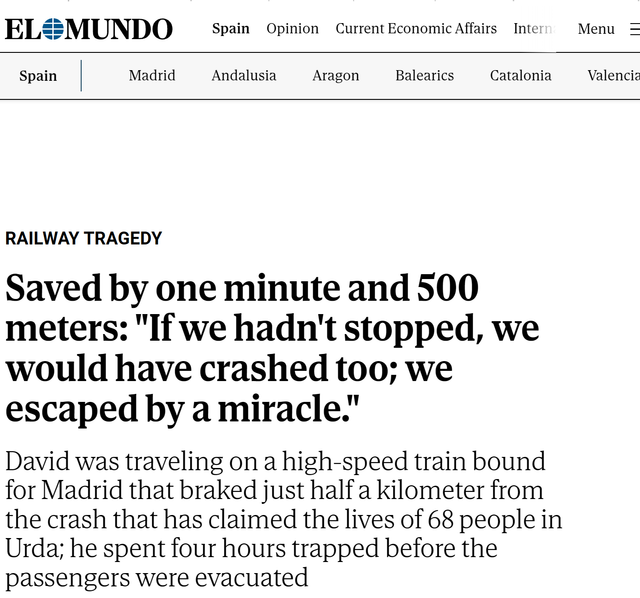
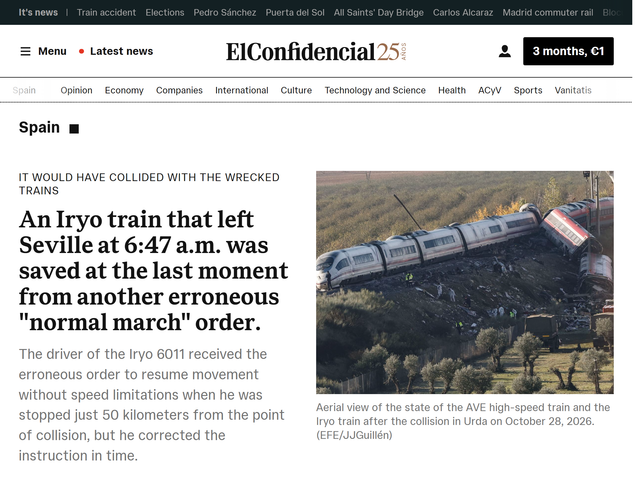
There are reports in the Spanish media, unconfirmed, that two other trains in the area affected by the system failure were given instruction to proceed at line speed, one in each direction heading to the incident location. One driver refused the instruction and the other proceeded, only to be stopped when the OHLE failed following the collision.
Had that first driver acceded to the instruction to proceed and had the OHLE stayed energised...
Screenshots of Google translated news items from El Mundo and El Confidencial.
| Re: Spain - 69 dead after two trains collide south of Madrid - 28 October 2026 Posted by grahame at 22:49, 30th October 2026 | |
Not sure of the veracity of this ...
Malaga-Madrid flight fares rocket to up to 400 euros. Passengers are calling for a cap on all fares for alternative modes of transport in the wake of rail tragedies such as the one in Urda.
